

New airflow technology tools can give you access to functionalities and capabilities that were previously unattainable. With the FlowMarker portable fogger machine you can evaluate and optimize airflow patterns, identify turbulence, test filters, and detect leaks. Designed for the requirements of BSCs (Biological Safety Cabinets) and other laboratory containment devices, the fogger machine allows you to ensure air inflow is sufficient and exhaust is properly managed. It is also ideal for verifying the operational quality and safety of cleanrooms and is used to assess and optimize ventilation in medical, food, HVAC, and other applications.
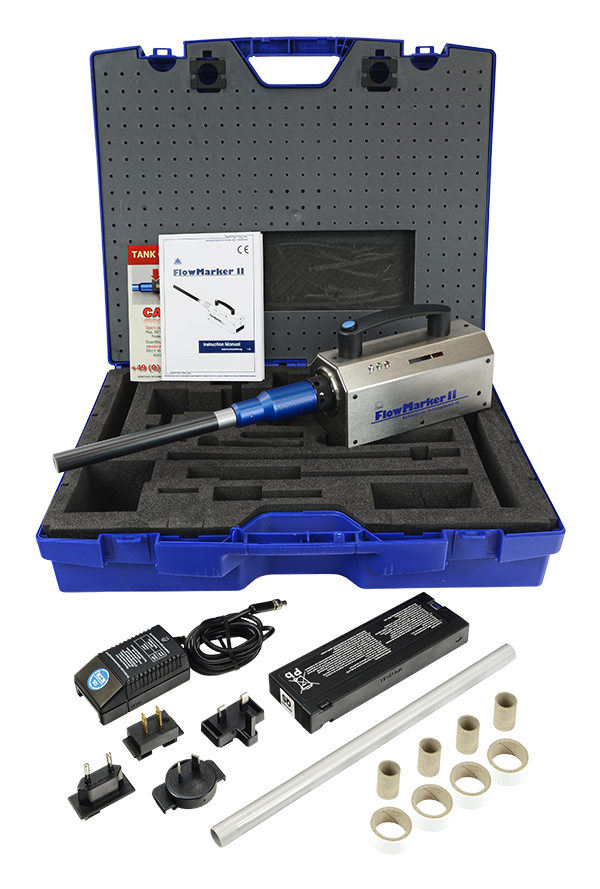
The FlowMarker comes in its own carrying case with all necessary components for operation including application tube, battery with charger, and fog fluid. Generating a long-lasting, thermally inactive fog, the handheld fogger allows you to accurately trace air currents without impacting flow patterns. It can be used in manual mode or operated with a remote control, and fog fluid is harmless, germ-free, and causes no residue in the environment where it is used.

If you need to move around the containment room, or apply fog to a further away location, the Hydra Tube System extends the range of fog generation with up to 5m (16’) of flexible tubing for the FlowMarker. The Hydra fan delivers fog through the extension hose, and the fan controller allows you to adjust the fog flow rate.
The portable fogger machine provides valuable airflow visualization in biotech labs, pharmaceutical suites, and other controlled environments. Gain the capability to optimize airflow in your critical containment space with a FlowMarker now. It is ready to be shipped to you.
The FlowMarker is used for a variety of airflow studies such as:
- Engineering airflow visualization – Commissioning, qualification, and validation testing to verify that airflow systems meet or exceed design specifications.
- Static airflow visualization – Analyze the baseline airflow patterns in a controlled environment at rest, without people moving or equipment operating.
- Dynamic airflow visualization – Assess how airflow in a cleanroom or critical containment space is affected by activities in and around the area.
- Diagnostic airflow visualization – Investigate the source of turbulence, leaks, and other airflow issues.