
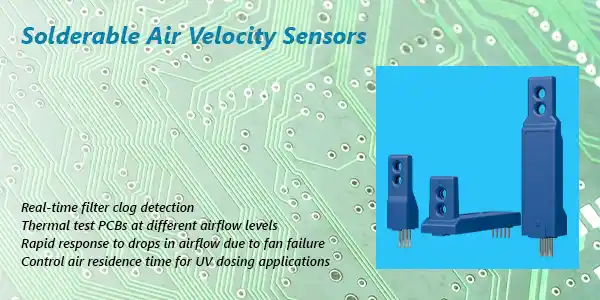
The demands for miniaturization, energy efficiency, and complex features continue to drive electronic product designs. Understanding the airflow impedance of the board assembly is critical, as it forms the basis for fan selection, establishing plenum openings, and heat sink design. The F66x through-hole air velocity sensor platform from Degree Controls is specifically designed to provide real-time feedback in air-cooled electronic systems and enclosures.
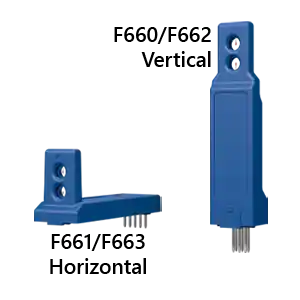
F66x sensors measure air velocity and temperature simultaneously and are through-hole devices, well suited for high-reliability products requiring strong connections between layers. Where PCB (printed circuit board) space is limited, the slim, vertical F660 and F662 sensors provide the smallest footprint whereas for arrangements where a number of PCBs are stacked, or Z-height is otherwise constrained, the low-profile F661 and F663 sensors are ideal.
PCB board mount sensors offer velocity ranges from 0.15 to 20 m/s (30 to 4,000 fpm) and communicate across an I2C or UART bus. They can also be configured with an alarm output for switch-style operation.
Give PCB designers and packaging engineers the data they need to develop an optimal system by using the F66x through-hole air velocity sensor to test physical models of electronic components and characterize board assemblies. Please contact us today if you would like further information about through-hole air velocity sensors.
Embedded board-mount air velocity sensors have proven to be invaluable in products where system performance depends on how fast the air is moving. They are easy to place on PCBs, lower the PCB footprint, and can be soldered directly to the board or mounted with a surface-mount socket. All F66x PCB mount air velocity and temperature sensors include calibration and temperature compensation in a single package.