
Do you want to optimize plant growth and crop yield?
The F400 indoor farming airflow sensor provides air velocity and temperature data for controlled environment agriculture (CEA) managers to optimize airflow. It empowers them to create ideal growing conditions, enhance plant health, and increase crop yields.
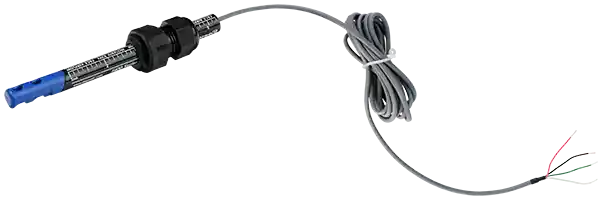
Environmental conditions can be continuously monitored and dynamically adjusted by transmitting F400 velocity measurements to a control system. Fan and filter airflow can be tracked, and the air renewal rate (RIA) for the grow space determined. For a comprehensive view of air movement around plant canopies and throughout the farming facility, several F400s may be used.
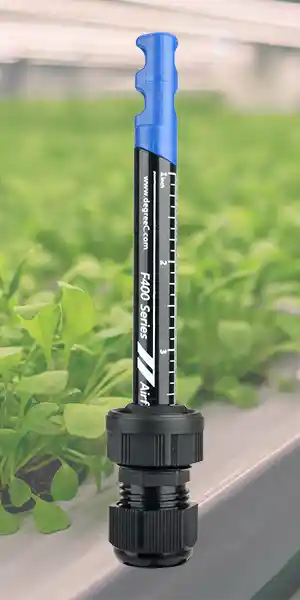
The F400 features analog outputs1. Air velocity and temperature measurements may be transmitted to a data logger, alarm, or PLC in real time, allowing you to characterize conditions in the growing area and identify potential issues quickly. Meeting the typical airflow speed targets for indoor farming, the F400 has a standard velocity profile of 0.15 to 1.0 m/s (30 to 200 fpm) and can be expanded up to 20 m/s (4,000 fpm) for crop-specific needs. Different sensor probe lengths are available to reach in and around the canopy. For applications which need increased flexibility with sensor placement, remote head versions of the F400 use a 1m cable to separate the sensing element from the sensor electronics.
A valuable tool for optimizing airflow in CEA facilities, the F400 indoor farming airflow sensor provides real-time data that allows for informed adjustments to the ventilation system.
1The F400’s analog output may be augmented with digital UART or I2C communication.
Why is air movement important in CEA? It helps build strong plants.
- Air movement facilitates gas exchange for photosynthesis.
- Air movement helps dissipate heat and cool plants down.
- Air movement can pull away moisture from plants, reducing humidity and helping to prevent fungal and other diseases.